June 24, 2026 · Bernard Williams
Avoiding Burnout While Climbing the Ladder
The Scenario

I'd like to introduce you to a fictional friend of mine named Priya. Priya has spent the last 12 years in IT infrastructure and operations, the kind of career built on long nights, incident bridges, and a reputation for being the person who figures it out. She was recently promoted to VP of Technology at a mid-sized financial services company. Eight months in, she is managing a team of 22, sitting in back-to-back meetings (many of which could have simply been an email) from 8am to 6pm, and then opening her laptop again after dinner to catch up on everything she was actually supposed to get to during the day.
On paper, Priya is succeeding. Her team likes her. The executives are satisfied. But she hasn't exercised in three months. She's short-tempered with her family. She dreads Sunday evenings. She told herself things would slow down after the first quarter. News Flash: They haven't.
The Question: What Should Priya Do?
There is a real and serious risk here, one that can quietly derail a promising leader's career before they even realize what's happening. Here's how I'd think about it.
The Hidden Cost of the Identity Shift
The transition from technical expert to leader doesn't just change your job description. It changes who you are expected to be, and that transformation carries a cost that most organizations never acknowledge.
When I made the shift from hands-on technologist to leading teams, I still felt the pull to be the person with all the answers. I had built my reputation on being technically sharp, and I wasn't ready to let that identity go. So I kept doing both, leading the team during the day and staying on top of the technical work at night. It was unsustainable, and it took me longer than I'd like to admit to recognize I was running two full-time jobs in one body.
Priya is likely doing the same thing. She's managing people, attending steering committees, and building executive relationships, all while staying deeply involved in technical decisions because that's where she feels most competent and most useful. Strategic leaders must make a choice: you can be the expert in the room, or you can be the leader who develops experts. Trying to be both, all the time, is the fast lane to burnout. There will always be occasions when you need to dip into your technical tool bag to move an issue/challenge forward; however, this should be the exception rather than the rule.
There is a moment in every newly promoted leader's first year where they have to formally let go of work they used to own. It feels like a small thing. A specific architecture review they used to chair. A specific Slack channel they used to monitor. A specific incident type they used to handle. The instinct is to hold on, because doing the work is what made you good. The actual leadership move is to hand it off and use the time you reclaim to do the work only you can do as a leader. That handoff is uncomfortable. It is also the price of admission for the next stage of your career.
Availability Is Not a Leadership Strategy
There's a belief that runs deep among high-performing IT professionals: that being available equals being valuable. Being first to respond on Slack. Taking the 10pm escalation call. Never saying you don't have bandwidth. I understand that mindset deeply. As a former enlisted Marine, I was trained to push through, to never quit, to do whatever it takes to accomplish the mission (whether it's your job or not). That mentality is necessary and can serve you well in some environments. However, over the long arc of a leadership career, if not applied correctly, it will hollow you out.
The problem with always being available is that it sets an expectation your team will mirror. If you're sending emails at midnight, your team feels the obligation to be watching at midnight rather than spending time with their friends and family and building a well-balanced life with healthy relationships. You aren't modeling leadership. You are modeling urgency, and urgency is not a culture. It's a symptom. (Think about how Stephen Covey talks about urgent vs. important.) You want to model a leadership and thought style that focuses on what's important before it becomes urgent.
The countermove is to be deliberately unavailable, in appropriate and visible ways, so the team sees you protecting recovery. Schedule a recurring block on your calendar called something specific (gym, walk, family dinner), and respect it the way you would respect a board meeting. Stop replying to non-emergency Slack messages after 7pm. When something is a legitimate emergency, be the first to respond and lead from the front. If you see something in email or slack that you want to reply to but is not an emergency, send it from a scheduled message the next morning instead of in real time. Each of these signals to the team that boundaries are professional, not weak or lazy.
I can tell you from experience that what I am proposing is not what typical corporate America is asking for. That doesn't mean I'm wrong or that this will not work. My approach is making one very large assumption: You are very good at what you do and know it.
There's a book I recommend to leaders navigating exactly this challenge: Essentialism by Greg McKeown. The core idea is straightforward. Do less, but do it better. Protect what matters. That principle applies directly to how you manage your energy and attention as a leader. Remember, leadership is not just deciding what needs to get done or where the team is going. It is also about achieving results through others vs trying to do all of it yourself.
Your Capacity Is Your Team's Ceiling
Here is the thing: I find that most leaders don't fully internalize this until they've already burned out once. While it doesn't have to be, your personal capacity as a leader can often become the ceiling for your team's performance.
When you are exhausted, your judgment degrades. You make reactive decisions instead of strategic ones. You stop developing your people because you don't have the bandwidth for real conversations. You stop seeing the big picture because you're busy fighting fires. The team feels it, even when they can't name it.
Leadership presence requires you to actually show up, not just physically, but mentally and emotionally. If you are running on empty, the people you lead are running on less. Protecting your own energy so that, when you are with your team, you can be fully engaged and plugged into their needs is not self-indulgence. It is a responsibility that you have to your team.
One of the things I have thought about doing more formally going forward is what I guess you could call a "What Sucks" audit. At the end of each week, write down two columns. What moved the needle in the right direction this week? What sucked and wasted your time? Look for patterns over a month. I bet most leaders will find that one or two specific recurring meetings, one or two specific people, and one or two specific recurring decisions are responsible for most of the drain. Once you can see the pattern, you can do something about it. Restructure the meeting. Coach the person. Change the decision process. The audit will make the invisible visible, and what's visible can be changed.
Priya needs to understand that slowing down is not falling behind. Smooth is fast. It is what allows her to lead sustainably and at the level her team actually needs.
Burnout Avoidance Anti-Patterns
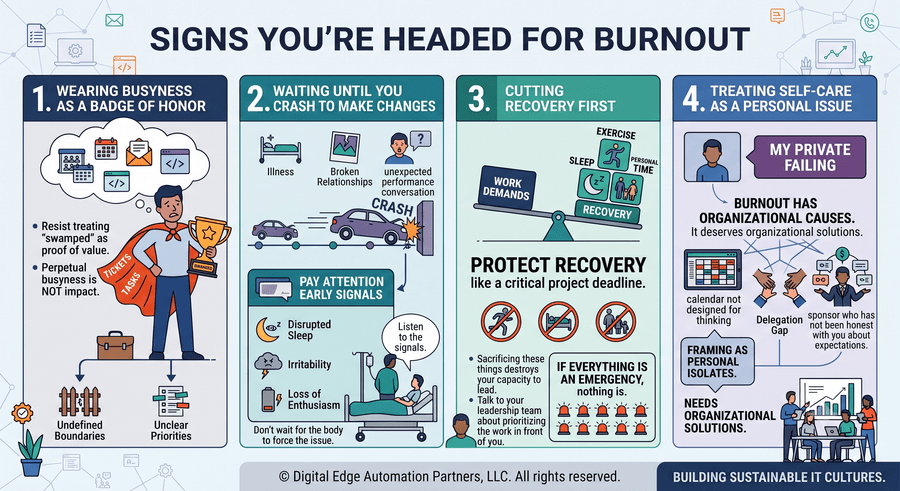
Wearing busyness as a badge of honor. In many IT cultures, being swamped is treated as proof that you matter and are valuable to the team. Resist this. Perpetual busyness is not a sign of impact. It is often a sign that boundaries haven't been established and priorities haven't been communicated clearly enough.
Waiting until you crash to make changes. Most leaders don't adjust until their body forces the issue: an illness, a broken relationship, a performance conversation they weren't expecting. Don't wait for the crash. The signals come early: disrupted sleep, irritability, a loss of enthusiasm for work you used to love. Pay attention to them.
Cutting recovery first. When time gets tight, leaders tend to sacrifice exercise, sleep, and personal time first. These are precisely the things that restore your capacity to lead. Protect them the way you would protect a critical project deadline. Talk to your leadership team about prioritizing the work in front of you. If everything is an emergency, then nothing is an emergency.
Treating self-care as a personal issue. When you frame burnout as a private failing, you isolate yourself and miss the structural fixes. The pattern is rarely just you. It is usually a calendar not designed for thinking, a delegation gap left unaddressed, and a sponsor who has not been honest with you about expectations. Burnout has organizational causes. It deserves organizational solutions.
Some Closing Thoughts
If you read this and recognized yourself somewhere in Priya's story, you are not alone. The drive that got you to this point, the work ethic, the technical excellence, the commitment to delivery, can quietly become a liability if you don't learn to channel it differently as a leader.
Leadership skills can be taught and learned. Sustainable leadership requires you to invest in yourself the same way you invest in your team. Start small. Reclaim one hour. Set one boundary. Tell one person no. Work daily toward the leader you want to become, not just the one the calendar says you already are.
Key Takeaways
- The identity shift from expert to leader is real and quietly expensive. Most burnout starts there, not in the workload itself.
- Availability is not a leadership strategy. Being always-on models urgency, and urgency is not a culture.
- Your personal capacity is the ceiling for your team's performance. Protecting your energy is a responsibility, not a luxury.
- Be deliberately unavailable in visible ways. Boundaries are professional, not weak.
- The energy audit makes the invisible visible. Track what gives and takes energy for a month. Patterns emerge that you can actually act on.
- Cut everything before you cut recovery. Sleep, exercise, and personal time are what rebuild capacity to lead.
- Burnout usually has organizational causes. Solve it as a leadership problem, not a personal one.
Call to Action
Before you close this tab, do one thing: look at your calendar for next week and find one block of time you can reclaim. Not a vacation. Not a sabbatical. One hour. Put it on the calendar with a specific protective label (workout, walk, family dinner) and treat it as non-negotiable. That one hour is the first deposit in the recovery account that funds the rest of your leadership career.
If you found this useful, sign up for the Tech Leader Playbook newsletter by clicking the subscribe button on our home page. Every issue helps mid-career tech leaders sharpen the skills that move careers and teams forward. Join the community. Grow your leadership. Here is a quick guide that you can use to assess yourself.
Related reading: Why Tech Leaders Need to Think Like Business Owners and From Tech Expert to Strategic Leader — Making the Shift in 2026 on the godeap.io blog.